
1. Biochar is produced through pyrolysis — either in the simple Kon-Tiki or in technical installations. How do these methods differ in terms of efficiency, controllability, and later applications in plant soils?
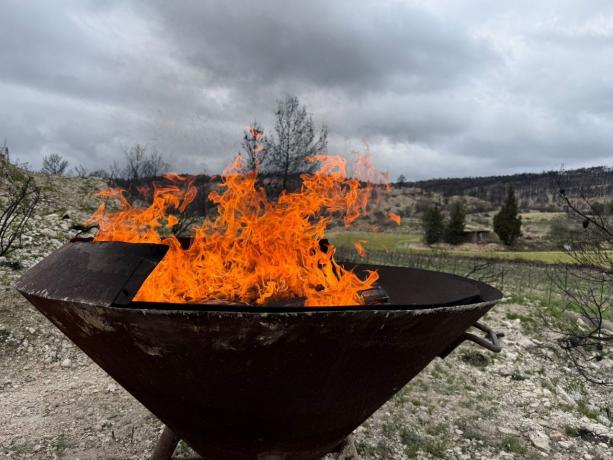
Biochar from the Kon-Tiki has proven itself for agricultural use time and again — it easily meets the requirements of the highest biochar certificate, EBC-AgroBio. And the simple Kon-Tiki costs a fraction of an industrial plant, both to buy and to run. Where industrial installations hold a real advantage is emissions: they capture the pyrolysis gases completely and route them through a controlled burner, which breaks down the organic compounds in the exhaust far more thoroughly and releases less methane. Kon-Tiki emissions are lower than open fires or uncontrolled composting, but well above those of industrial pyrolysis (see our paper: Methane Emissions from Flame Curtain Pyrolysis). Industrial devices also achieve higher carbon efficiency, since the heat and other by-products of the process can be put to use. As for the biochar itself — its quality is comparable with what comes out of the expensive industrial route and meets the highest EBC requirements.
2. What role does “charging” the biochar play — the introduction of nutrients and microorganisms — before it is used in soil? Are there decisive success factors here from your perspective?
Mixing biochar with organic nutrients is, in our experience, the single most important thing you can do. It is not about filling pores with liquid NPK fertilizer — it is about embedding the char in a microbially active environment. Bokashi is close to ideal for this: the soil microbiome gets food, and the biochar helps it digest. You can also ferment the char in other ways, soak it in urine, co-compost it, work it into manure, or feed it to livestock. The point is always a healthy, biologically active substrate. Biochar amplifies it — but cannot stand in for it.
3. Terra Preta is often cited as a model. What can realistically be transferred — and where do modern applications reach their limits, for instance with regard to timescales or microbial complexity?
The key difference between Terra Preta and biochar use in the North is climate. In the humid tropics, biological activity in the topsoil is so fierce that organic matter is consumed almost the moment it arrives. Soil organisms are essentially starving — so despite heavy organic inputs, barely any humus builds up. Biochar buffers that: it stores organic nutrient complexes that stay available for soil carbon formation instead of being devoured at once. Our temperate climate works differently. We have alternating wet and dry spells, real winters, and soils far richer in clay and minerals than the Amazon. In the German lowlands, in France, across the American Midwest, you can build carbon-rich soils without biochar — but biochar helps it happen faster and with less organic input. The underlying principle, though, is the same everywhere: biochar embedded in composted or fermented organic residues — crop waste, food scraps, animal and human manure. That is how it was done in the Amazon, and that is how it should be done now. In temperate climates, where agrochemistry already pushes yields near their ceiling, higher harvests are hardly the point. But the Terra Preta approach can still improve the resilience and quality of organic production — in the South and in the North.
4. Looking at soils as living systems: how does biochar change the interplay of physical, chemical and microbial processes — and where do you still see a need for research?
With over 10,000 scientific publications on biochar in soil, you might expect the biological complexity to be well understood. Unfortunately, it is not. The vast majority of studies isolate single variables — which is how science works, but it misses the point of biological systems where everything interacts. The result is a strange gap: practitioners — gardeners, livestock farmers, smallholders — are routinely getting excellent results with biochar in complex biological setups, yet formal trials can rarely reproduce what practitioners achieve. This is not unique to biochar; you see the same pattern across biological agriculture. Practice runs ahead of the science that is supposed to explain it.
5. In projects such as the Stockholm Tree Project, biochar is deliberately deployed in urban settings. What role does it play there — and what can agricultural systems learn from it?
Urban soils are about the hardest environment a tree can face. They are biologically dead, starved of organic input, and the rain that reaches them carries heavy metals, salts, PAHs and worse — when it comes at all. Biochar keeps the root zone aerated and moist, which is already half the battle. Without it, compost brought into those conditions would simply rot and do more damage than good. Combined with biochar, the biology and nutrients of a well-matured compost stay stable and actually reach the roots. Biochar is also used in special tree substrates that are used to replace urbans soil with a porous matrix of gravel and stones. You can periodically recharge the embedded biochar with organic liquid fertilizer — keeping the whole system alive over time.
That approach can be adapted for agroforestry or for rehabilitating contaminated land. But for ordinary agriculture, it would not only be too laborious — it would be solving the wrong problem. A depleted field does not need engineered root pits. It needs humus-building and living niches created across what is, in effect, a biological desert.
6. Biochar projects differ enormously worldwide in their framework conditions — from smallholder systems in Nepal to technical applications in Europe. Which factors are decisive, in your view, for such approaches to work in the long term?
Industrial biochar production is expensive — far too expensive for per-hectare agricultural yields to justify. For smallholders and home gardeners, the Kon-Tiki is a different story: it produces biochar essentially for free, using whatever organic residues are to hand. For larger farms, the economics shift again. A small automated pyrolysis unit can process on-farm biomass, deliver cheap heat to the farmstead, and produce biochar as a co-product. The heat pays for operating the plant. Carbon-removal certificates from the biochar pay for buying it. And since the feedstock costs nothing, the biochar ends up cheap enough to use everywhere — in the stable, the compost, the field.
Cooperatives can scale this further: several farms sharing a larger plant with a local heating network, each using the biochar on their own land. For industrial-scale production aimed at the open market, the real future lies elsewhere — in asphalt, concrete, plastics, and other material applications.
7. Biochar is increasingly being applied outside agriculture as well, for instance as a building-material additive or in technical products. Where do you see the greatest potential here?
The moment we get serious about replacing the fossil carbon we can no longer afford to extract, biochar becomes one of the key raw materials — petrochemistry gradually turning into biochemistry. While the principal pathway to replace fossil carbon will be CO₂ extracted from the atmosphere and synthesized into methanol using renewable energy, biochar and pyrolysis oil could equally be synthesized into products like plastics, carbon fibres, and bitumen. Biochar could also be used as an additive in asphalt, construction materials, plastics, textiles, and composites (see our article “The Plastic Hope”). What is already emerging from pilot projects in the building and plastics industries is encouraging — biochar in these materials is not just a climate measure but often improves performance and durability as well.
8. Highly visible projects — in professional sport or municipal initiatives, for example — bring the topic into the public eye. How important is this societal dimension for the spread of biochar?
It matters enormously. Popularising biochar has done more to move the topic into politics and regulation than any number of papers. Public authorities have often been slow — but at EU level, at least, the key legal frameworks are now in place. Biochar is also one of the best teaching tools we have for making carbon cycles and negative emissions technologies tangible. Hold a handful of black char: what you are looking at was CO₂ in the atmosphere a few months ago, captured by a plant, and locked into stable form through pyrolysis. That is a story people grasp immediately.
9. The Swiss Federal Office for the Environment recently published a position paper advising against the broad use of biochar in agriculture. This surprised many in the biochar community — not least because Switzerland was the first country to officially legalise certified biochar as a soil amendment, back in 2013. How do you read that?
It is a frustrating step backwards, and it rests on surprisingly thin reasoning. The core concern — that biochar might harm soil organisms — is legitimate in principle but answered in practice. The European Biochar Certificate, EBC-Agro, sets binding limits for heavy metals, polycyclic aromatic hydrocarbons and other contaminants, enforced through regular independent testing. Anyone applying EBC-certified biochar can effectively rule out a contamination risk and any contaminant-related impact on soil organisms.
The Federal Office refers to few studies showing adverse effects on soil biota. All of them use high application rates and poorly-characterized biochars – so there is no proof that correctly certified quality biochars have such negative effects. There is a single, not yet published study from Switzerland, which by hearsay showed negative effects on earthworms in the second and third year after application of eight tons certified biochar per hectare but this effect was transient and not detectable thereafter. No need to discuss this any further. Issuing a blanket warning based on an unpublished study that used extreme biochar application rates, without distinguishing between product quality and application rate, is not precaution. It is imprecision dressed up as caution.
The precautionary principle deserves better than that. Nobody in the biochar sector opposes long-term research or transparent data — we have been building both for over fifteen years. But the evidence we have for certified biochar at realistic field rates does not support a general advisory against its use. A warning that fails to differentiate between uncertified charcoal dumped at fantasy dosages and quality-controlled biochar applied at agronomic doses does not protect farmers. It confuses them — and it undermines one of the few genuinely effective, field-ready tools for soil carbon and climate action that we actually have.
10. Roughly five years ago, biochar applied to soil was first marketed as a carbon sink to offset CO₂ emissions. Since then, biochar has become the largest negative emissions technology on the market. How has this climate hype changed the industrial biochar sector?
The market has grown exponentially, and that growth has brought real benefits — investment, visibility, infrastructure that would not exist otherwise. But it has also introduced a structural distortion that the sector is only now beginning to reckon with.
When the dominant revenue model is the carbon certificate rather than the biochar product, the incentives shift. Production scales up to generate certificates, not to develop applications. Biochar becomes a by-product of its own certificate. In some cases, it is even handed out for free, because they only sell the carbon removal it represents and their business model is based on fast scaling like the internet economy. At Ithaka we helped build the certification architecture that made tradeable biochar carbon sinks possible, so this is not a criticism from the sidelines. It is a structural problem we need to face honestly.
Quality biochar cannot be produced in Europe for less than 600 to 1,000 euros per tonne — that floor is real and it is not coming down. CO2-offsets for biochar C-sinks can subsidize some 25 to 30% which is undoubtedly good to bring prices down for biochar users. However, investor-backed companies, whose business model depends nearly entirely on certificate revenue, have produced more biochar than the current market can absorb. Some of these companies pressed down costs through quality and technology downgrades, and are giving biochar away at or below cost. The negative side effect is that self-financed quality producers lose customers. And even when some of those investor-driven companies go bankrupt — as some inevitably will — the biochar they overproduced is already out there. The surplus does not disappear with the company. It stays in the market and keeps distorting it.
There is a deeper vulnerability, too. Biochar carbon sinks trade exclusively on the voluntary market, which can shift overnight when major buyers change strategy as has happened recently. It is a speculative space, not based on the right fundamentals. That would change the moment CDR enters the regulated market — but we are not there yet. However, it is always easier to build a lasting business around a product that users love and apply with visible results than around one that nobody ever sees — a product whose value exists only on paper and ends as a line in a ledger (see also the tBJ article: Does Climate Marketing Kill Biochar).
How the sector redirects its focus toward biochar products that genuinely serve those who use them — that will be the interesting challenge of the coming years.
11. Looking to the future: what concrete role can plant soil containing biochar play in agriculture — between climate protection, soil fertility and economic practice?
I will be candid: despite everything we have discussed — the farm-scale plants, the cooperatives, the carbon certificates — I believe biochar will remain a niche within a niche. It works properly only in organic systems, and those systems are too complex and too context-dependent for the efficiency-driven logic of industrial agriculture. The climate benefit of soil-applied biochar is real and measurable, but it can cover only part of the cost, and it will probably not drive adoption at continental scale.
That said, a niche is not nothing. For anyone willing to work with living soil — farmers, gardeners, smallholders, cooperatives — biochar is one of the best tools available: a way to regenerate your own land, close nutrient loops, buffer against drought and heavy rain, and quietly sequester carbon while you are at it. It will not turn agriculture into a climate saviour. But it can make your own patch of ground more alive, more resilient, and improve your own climate balance.
Where biochar is already proving itself at scale is in animal husbandry — as a feed supplement and in manure management — and in the treatment of organic waste streams, where it can help eliminate microplastics and PFAS while recycling both nutrients and carbon. These are not speculative applications. They are happening now.
We thank Thomas Schäffer for the idea of the interview and the structured questions. The original interview will be published in the German Journal MIKROSphäre (2026).
Note of the editor: In an earlier version Hans-Peter's reply to the first question regarding the Kon-Tiki biochar quality read: Industrial devices also achieve higher carbon efficiency, since the heat and other by-products of the process can be put to use. As for the biochar itself — its quality is no different from what comes out of the expensive industrial route. Given the slightly ambiguous meaning, Hans-Peter reformulated his reply to: As for the biochar itself — its quality is comparable with what comes out of the expensive industrial route and meets the highest EBC requirements.
- Please write us your comment -
×